
How PEK Tubular Membranes Treat Oily Wastewater
Understand free, dispersed and emulsified oil, PEK tubular membrane crossflow separation, pretreatment and operating considerations, with a 500 m³/d oilfield produced-water project reference.
Oily wastewater treatment starts with identifying how the oil is present. For suitable oil droplets and oil-bearing particles, pretreatment combined with PEK tubular membrane crossflow filtration can remove oil and suspended solids. Whether the treated water meets reuse or discharge requirements also depends on dissolved contaminants and the requirements of its intended use.
1. Why is oil concentration alone not enough?
Oilfield produced water, refinery wastewater and machining washwater present different treatment challenges. Even when total oil concentrations are similar, droplet size, emulsion stability, suspended solids, surfactants and temperature may call for different treatment combinations.
Free oil
Under suitable conditions, free oil rises and forms a separate layer. An oil separator or another appropriate oil–water separation stage is normally used first to reduce the load.
Dispersed oil
Smaller oil droplets are dispersed in the water. Separation depends on droplet size, feed conditions and the treatment method used.
Emulsified oil
Surfactants can stabilize oil droplets. Demulsification, coagulation or flotation may need to be evaluated before the membrane separation process is selected.
Oil attached to particles
Oil enters the system with suspended solids and colloids. Solid–liquid separation, concentrate discharge and deposits on the membrane surface need to be considered together.
Dissolved contaminants need separate attention. Truly dissolved hydrocarbons and other small organic molecules may pass through microfiltration or ultrafiltration membranes. Good oil removal does not automatically mean that COD, salinity or other parameters meet the required limits.
2. How do PEK tubular membranes separate oil?
Oily wastewater flows through the membrane channels. Driven by transmembrane pressure, water and dissolved components that can permeate the membrane pass through the membrane layer to form permeate. Retained oil droplets and suspended particles remain on the concentrate side, where recirculation and controlled discharge manage the retained material.
Crossflow filtration uses flow along the membrane surface to limit the buildup of deposits. This helps process complex feeds containing oil and solids, but it does not eliminate fouling. Oil adhesion, emulsion stability, viscosity and particle properties still affect flux and cleaning intervals.
Assess the whole module
PEK’s chemical resistance and mechanical properties support demanding applications. Selection should also check temperature and pressure limits and chemical compatibility for the membrane layer, seals, housing and connections.
Design for cleaning
Select cleaning agents, concentration, temperature and contact time to suit the oil and organic deposits. Stronger chemicals do not necessarily clean more effectively.
3. How should pretreatment and tubular membranes be combined?
A common engineering approach is to reduce the bulk of the readily separable oil and solids first, then use suitable conditioning and tubular membrane separation for the remaining droplets and particles. Downstream stages are selected according to the reuse or discharge target.
Remove readily separable free oil first
Use gravity separation or another suitable oil–water separator to limit the amount of bulk free oil entering the membrane system.
Condition stable emulsions where necessary
Select demulsification, coagulation or flotation measures based on feed testing. Chemical type and dose should be verified with actual water samples.
Apply PEK tubular membrane crossflow filtration
Separate oil droplets and suspended solids that can be retained, while controlling recirculation conditions, membrane flux and concentrate discharge.
Check permeate against its intended use
Reinjection, process-water reuse, NF/RO feed and discharge have different requirements. Biological treatment, adsorption or other polishing may be needed.
This is a process-selection framework; a particular project may use only some of these stages. Oil separation, flotation and tubular membranes perform different duties. Recovered oil, flotation sludge, concentrate and spent cleaning solutions also need defined handling routes.
4. How should oil-removal performance be evaluated?
For applicable oily wastewater treatment conditions, Plum’s tubular membrane brochure lists reference performance of permeate oil below 5 mg/L and oil removal of at least 99%. These figures relate to a suitable combination of pretreatment and membrane separation. They are not a universal guarantee for a single membrane element treating every type of feed.
For a new project, verify both feed and permeate oil concentrations and the analytical method, and test representative water samples. Removal efficiency, permeate oil concentration and final reuse-water quality must be evaluated under the same operating conditions.
| What to check | Why it matters |
|---|---|
| Oil concentration, form and droplet size | Establishes oil loading, separation challenges and pretreatment needs. |
| Suspended solids and chemical additives | Helps assess membrane deposits, emulsion stability and cleaning compatibility. |
| Flux, transmembrane pressure and temperature | Tracks permeate capacity and filtration resistance and supports comparison between operating periods. |
| Cleaning effectiveness and frequency | Assesses restoration of permeate capacity, maintenance effort and actual availability. |
| Permeate oil, SS, COD and salinity | Checks reinjection, reuse or downstream requirements and identifies contaminants needing further treatment. |
Technical literature is available in the Download Center; see the tubular membrane oil-removal process package for the process route.
5. Project reference: 500 m³/d oilfield produced-water oil removal
Settling, flotation and tubular membrane separation
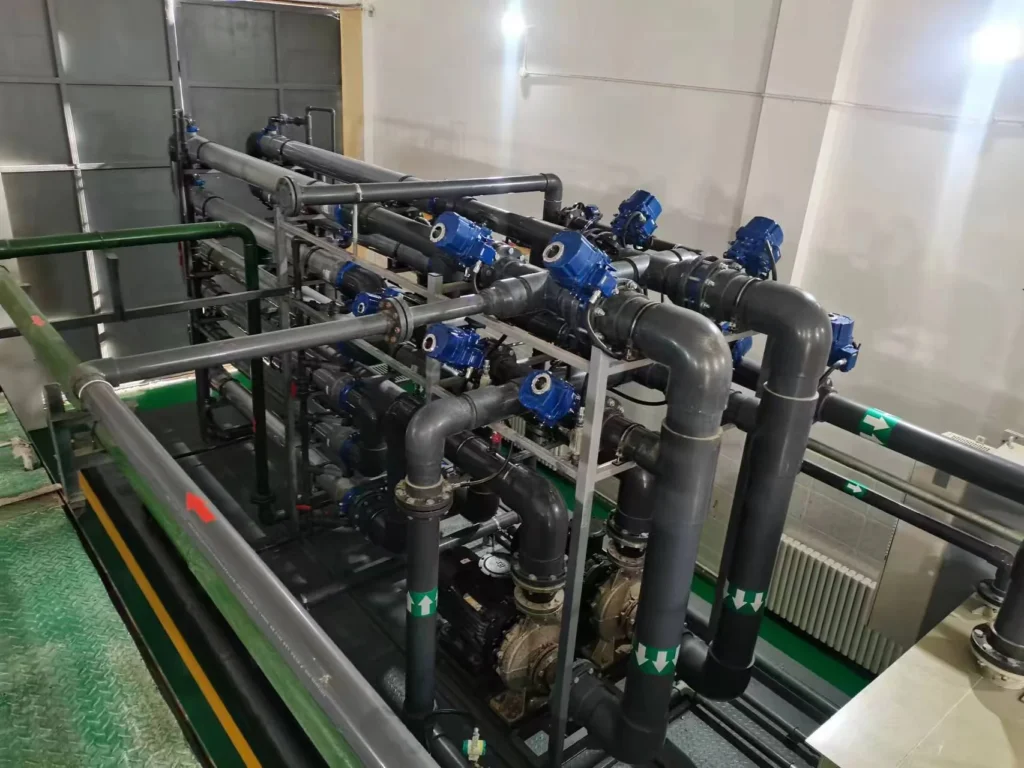
This project has a treatment capacity of 500 m³/d and treats oilfield produced water. Oil and suspended-solids removal supports downstream reinjection. The photograph in this article shows the project’s PEK tubular membrane equipment.
Gravity settling → Dissolved air flotation → PEK tubular membranes
Plum supplied the PEK tubular membrane system for this project. Positioned after settling and flotation, the membrane stage provides further oil removal and solid–liquid separation, illustrating how the stages perform complementary duties.
6. What supports stable operation?
- Manage changes in the feed: Watch for oil-load surges, batch discharges of cleaning wastewater and changes in surfactants. Use equalization, segregation or additional pretreatment where required.
- Interpret pressure and flux together: Track transmembrane pressure, recirculation pressure drop and permeate flow to identify fouling trends, rather than relying only on higher pressure to maintain output.
- Control the degree of concentration: Avoid excessive accumulation of oil and solids. Check viscosity, scaling risk and the concentrate discharge strategy.
- Verify recovery after cleaning: Use a compatible cleaning procedure suited to the deposits and set maintenance intervals from operating trends.
Operating-cost assessment should include recirculation-pump energy, chemicals, cleaning, downtime and residual-stream treatment, rather than comparing only membrane-element price or initial permeate flow.
Frequently asked questions
Can PEK tubular membranes treat emulsified oil?
They can be evaluated for suitable emulsified-oil separation duties. Performance depends on droplet size, emulsion stability, membrane specification and pretreatment. Stable emulsions may require demulsification or other conditioning first.
Can tubular membranes replace oil separation and flotation?
This depends on the feed. Large amounts of free oil or stable emulsions often still require upstream treatment. Appropriate pretreatment helps reduce membrane loading and operating fluctuations.
Can clear permeate be reused directly?
Visual clarity cannot replace water-quality testing. Oil, suspended solids, COD, salinity and the requirements of the intended use still need to be checked. Further treatment may be necessary.
Start with an actual water sample
To assess oily wastewater treatment, provide the source, flow and variability, oil and suspended-solids analyses, chemicals in use, existing pretreatment, and reuse or discharge targets. Plum can then assess the membrane separation duty and sample-testing needs.