WHEN TO VALIDATE
Which projects should validate samples before engineering design?
When published parameters cannot represent the actual feed, fouling, or cleaning behavior, experience-based scale-up can carry uncertainty into the project. Validation converts critical risks into measurable, reviewable boundaries before design.
Complex or highly variable feed composition
High suspended solids, oil, colloids, salinity, viscosity, or organics coexist, so one water-quality parameter is insufficient to determine membrane fit.
Product quality or selectivity is sensitive
Clarification, concentration, decolorization, fractionation, or purification projects require simultaneous observation of permeate, concentrate, and target components.
Fouling and cleaning boundaries are uncertain
Use operating cycles, differential-pressure changes, and cleaning recovery to determine whether fouling is controllable and to screen compatible cleaning strategies.
Scale-up risk is high
New feedstocks, new processes, high-pressure duties, or safety-sensitive projects require continuous data to support membrane area, circulation method, materials, and control boundaries.
- Feed
- Source, composition, variability, and safety properties
- Objective
- Clarification, retention, concentration, fractionation, or recovery
- Current process
- Existing flowsheet, constraints, and downstream interfaces
- Scale
- Sample conditions, target capacity, and operating mode
VALIDATION PATH
Move from one sample to data suitable for engineering discussion
Not every project requires every stage. Plum uses a decision gate at each point to continue, adjust the route, request more information, or stop an unsuitable approach.
- 01Decision gate: direct selection or testing required?
DESK REVIEW
Data pre-review
- Review the feed and separation objective
- Identify safety, transport, and analytical gaps
- 02Decision gate: define the bench-test scope
SAMPLE SCREENING
Sample screening
- Confirm sample representativeness and testability
- Define membrane candidates, analyses, and test boundaries
- 03Decision gate: continue, adjust, or stop
BENCH TEST
Bench validation
- Screen membrane routes and an initial operating window
- Observe flux, differential pressure, retention, and cleaning response
- 04Decision gate: sufficient evidence for scale-up?
CONTINUOUS PILOT
Continuous pilot
- Validate cycle length, stability, and mass balance
- Confirm controls, CIP, and upstream and downstream interfaces
- 05Output: proceed to process design or continue validation
DESIGN INPUT
Engineering design inputs
- Establish membrane area, materials, and operating boundaries
- Recommend the process route and next steps
EVIDENCE, NOT A SAMPLE ONLY
A valuable test delivers a basis for decision-making
Validation should answer why the route was selected, where its boundaries lie, and what remains to be verified. The analytical program and report depth are defined in the test scope against project objectives.
Project-specific content follows the mutually approved test scope
- 01 Membrane-fit assessment
- Candidate membrane types, screening logic, and suitable and unsuitable duty boundaries.
- 02 Operating window
- Time-based records of flux, pressure, temperature, concentration factor, or circulation conditions.
- 03 Separation results
- Record key permeate and concentrate parameters and material destinations against the objective.
- 04 Fouling and cleaning
- Differential-pressure or flux change, cleaning response, recovery, and risks requiring further confirmation.
- 05 Continuous-run performance
- Pilot-cycle stability, response to variation, control points, and operating records.
- 06 Next-step recommendation
- Recommendation to proceed to engineering design, adjust pretreatment, add testing, or stop the current route.
TEST PLATFORM
Configure equipment around the validation task, not one model in place of process judgment
The available platforms cover microfiltration, ultrafiltration, nanofiltration, reverse osmosis, and dedicated tubular membrane routes. Membrane type, pressure class, wetted materials, controls, and safety configuration must match the sample and test objective.
Standard tubular membrane platform
- Membrane type
- PVDF / PEK tubular membrane
- Pressure reference
- <5 bar
- Control
- Manual control with real-time temperature and pressure display
Automated explosion-protected tubular membrane platform
- Membrane type
- PVDF / PEK tubular membrane
- Pressure reference
- <5 bar
- Control
- Automatic control + explosion-protected configuration
Standard spiral-wound membrane platform
- Membrane type
- 4040 UF / NF / RO
- Pressure reference
- 2–28 bar
- Control
- Manual control with real-time temperature and pressure display
High-pressure spiral-wound membrane platform
- Membrane type
- High-pressure NF / RO
- Pressure reference
- Up to 80 bar
- Control
- Confirmed by project
Automated explosion-protected spiral-wound membrane platform
- Membrane type
- UF / NF / RO
- Pressure reference
- Configured to the project pressure class
- Control
- Automatic control + explosion-protected configuration
PUBLIC MODEL EXAMPLES
Public model examples indicate platform scale, not a fixed test plan
Only clearly bounded example fields from source documents are shown. Capacity is an equipment-data range and does not represent stable permeate production or engineering design flux for any sample.
| Model | Membrane configuration | Capacity | Pressure / temperature | Wetted materials | Control boundary |
|---|---|---|---|---|---|
| PL-G4-1000-M | 4 × 1″ × 1 m PVDF / PEK tubular membranes | 20–100 L/h | <5 bar / ≤60℃ | 304 / 316 / 2205 / UPVC / CPVC | Manual valves; temperature and pressure display |
| PL-G8-1000-A-EX | 8 × 1″ × 1 m PVDF / PEK tubular membranes | 40–200 L/h | <5 bar / ≤60℃ | 304 / 316 / 2205 / UPVC / CPVC | Automatic + explosion-protected; project safety review required |
| PL-D3-4040-M | 3 × 4040 UF / NF / RO spiral-wound elements | 50–200 L/h | 2–28 bar / ≤80℃ | 304 / 316 / 2205 | Manual valves; temperature and pressure display |
| PL-D3-2540-M-HP | 3 × 2540 high-pressure NF / RO spiral-wound elements | 10–50 L/h | 2–80 bar / ≤80℃ | 304 / 316 / 2205 | Controls and safety configuration require technical approval |
An automated explosion-protected spiral-wound platform can be configured by project. Membrane specification, pressure class, electrical design, and explosion-protection requirements are confirmed after sample safety review and technical approval.
SAMPLE & DATA READINESS
Better input data enables validation to answer the real engineering question
Plum first confirms sample quantity and analytical scope against the project objective; this page does not promise one sample quantity or a fixed schedule. Solvents, flammable or explosive materials, toxicity, biological risks, or special storage and transport conditions require prior safety-data review.
Project and process data
- Feed source, industry, and existing process
- Current capacity, operating mode, and primary constraints
- Quality requirements for the target product, permeate, or concentrate
- Planned project scale and upstream and downstream interfaces
Sample and analytical data
- Representative sample and available quantity
- Applicable data such as pH, temperature, viscosity, TDS, SS, oil, and COD
- Target components and components that should not pass or be retained
- Existing bench-test, filtration, or cleaning records
Safety and transport data
- SDS, hazardous components, and biological-risk statement
- Storage temperature, light protection, sealing, or time-limit requirements
- Transport, opening, disposal, and site-protection conditions
- High-pressure, explosion-protection, or special electrical requirements
Submit the available data and the problem to be solved. Plum can use it to identify the initial information gaps.
SCALE-UP DECISION
A feasible test does not by itself establish an engineering commitment
Before scale-up, test observations must be converted into design boundaries. Data stability, sample representativeness, run duration, and risk level together determine whether a project proceeds to pilot validation or engineering design.
Usable operating flux, circulation conditions, recovery, and decline trend
Membrane area, train count, pumps, and circulation boundaryContinuous cycle, differential-pressure change, cleaning trigger, and recovery record
Operating cycle, CIP logic, and redundancy strategyTemperature, pressure, pH, corrosion, solvents, and safety conditions
Wetted materials, seals, electrical design, and control requirementsPretreatment, concentrate, permeate, and downstream quality requirements
Process interfaces, material destinations, and design responsibility boundaryValidation data establishes project-specific boundaries and cannot be applied directly to another project without the corresponding sample, equipment, analytical method, and operating conditions.
PUBLIC PILOT RECORD
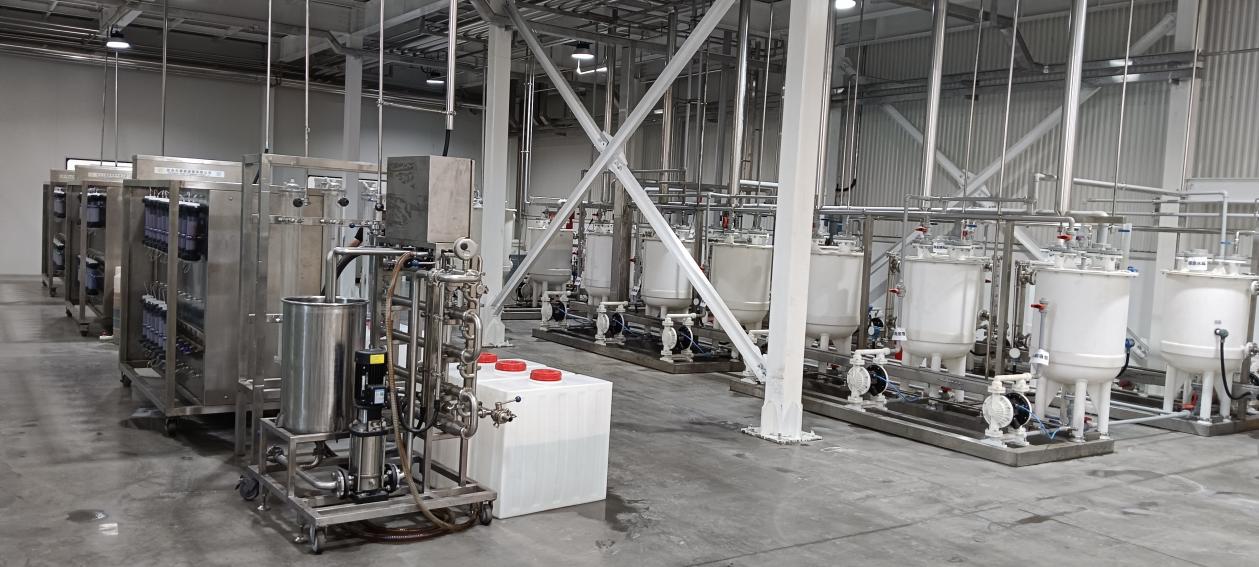
Public pilot record: from laboratory work to continuous operation
This record demonstrates Plum continuous-pilot capability and multi-membrane integration experience. It is not a treatment-performance or design-value commitment for another project.

2024 · 500 L/h
Pilot project for lithium recovery from salt-lake brine and ore
The pilot platform bridges laboratory work and industrialization. It validated an integrated route under continuous conditions for salt-lake brine and spodumene extract and generated a data basis for subsequent scale-up.
- Feed
- Salt-lake brine and spodumene extract
- Route
- PEK tubular ultrafiltration + resin adsorption + NF + high-pressure RO
- Validation task
- Continuous stability, separation route, and engineering scale-up data
Complex industrial wastewater
Validate solids separation, oil removal, softening, or downstream NF/RO protection routes.
Production and product fluids
Validate clarification, concentration, fractionation, purification, and target-component destinations.
High-pressure membrane separation
Validate NF/RO pressure windows, concentration boundaries, and integrated membrane routes.
BEFORE YOU APPLY
About sample testing and pilot validation
Submit the available information first. Plum will identify missing data, assess whether testing is appropriate, and determine the correct starting stage according to objectives and risks.
When should a project start with bench testing instead of direct engineering selection?
Bench testing is generally appropriate when feed composition is complex, target components are sensitive, fouling and cleaning behavior are uncertain, or published parameters cannot represent the real sample.
Does every project require pilot validation?
No. The need for a pilot depends on feed variability, continuous-operation risk, product-quality sensitivity, project scale, and the available scale-up evidence. Plum recommends the next stage after bench testing or data pre-review.
What data can validation provide?
Depending on the approved scope, outputs can include membrane-fit assessment, operating windows, permeate and concentrate analysis, fouling and cleaning response, continuous-run records, and scale-up recommendations.
How much sample is required and how long will testing take?
Sample quantity and duration depend on membrane type, analyses, circulation volume, continuous-run requirements, and sample safety conditions. Plum confirms them after data pre-review rather than using a universal commitment on this page.
Can solvent-containing, flammable, explosive, or high-pressure duties be validated?
These duties require an SDS, hazardous-component information, and operating data, followed by safety, wetted-material, electrical, and explosion-protection review before testing can be scheduled.
Is a bench-test result equivalent to an industrial project performance guarantee?
No. Test results are valid only for the corresponding sample, equipment, analytical method, and operating conditions. An engineering commitment also requires continuous-pilot evidence, scale-up factors, design boundaries, and a formal technical agreement.
Can a customer request witnessed testing or a site demonstration?
Witnessed testing, site demonstrations, or overseas technical demonstrations can be discussed during project evaluation. Method, timing, safety requirements, and responsibilities must be confirmed separately.
REQUEST SAMPLE TESTING
Submit the sample and validation objective for Plum assessment
Provide the available water-quality or process-fluid data, the question to validate, and sample availability. Plum will review the information before confirming test scope, required sample, safety conditions, and next steps.
This form supports preliminary project assessment and does not commit a test schedule, treatment performance, engineering performance, or safety configuration.